
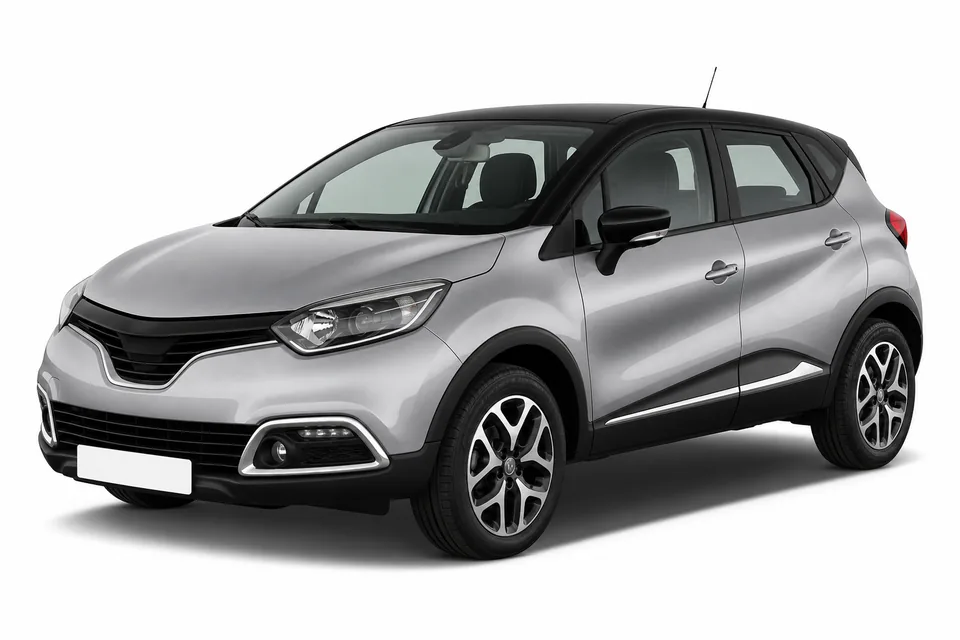
Renault Captur Problems in South Africa: the 2015-2021 Captur

The short version
- This guide covers the first-generation (J87) Captur, sold here from May 2015 and technically on sale, on very limited stock, until around the third quarter of 2021. The current Captur, which arrived in March 2023, is a different car and is not covered here.
- The fault to check first is the EDC dual-clutch gearbox on the 1.2 turbopetrol: hesitant at low speed, with several reported faults and outright failures.
- On the 0.9 three-cylinder, listen for a rattling timing chain and ask for proof of regular oil changes.
- Also reported: premature brake wear on numerous local cars, stop-start problems on some early cars, and creaky cabin trim on pre-facelift cars.
If you are shopping for a used Captur, or you already own one and something has started to feel wrong, this guide covers the car you are most likely dealing with: the first-generation, J87-series Captur. It arrived in South Africa in May 2015, and although Spanish production ended in 2019, it technically stayed on the market here until around the third quarter of 2021. The second-generation car only arrived in March 2023, so there is a clean gap between the two.1 Nothing below is about the newer car.
Two facts about the J87 are worth knowing before you go looking for parts. South African cars came from Renault’s Valladolid factory in Spain, and the car is built on the same “B” platform as the Clio IV, sharing much with its hatchback sibling.1 That Clio link comes up again below, because the 0.9 engine’s timing-chain warning was made earlier about the Clio.
Which Captur do you have?
Most of what goes wrong on a Captur depends on the engine and gearbox, so pin those down first. The line-up was short, which helps.
| Period | Engine | Output | Gearbox | Trims |
|---|---|---|---|---|
| May 2015 launch | 0.9 turbopetrol, 3-cylinder | 66 kW / 135 Nm | 5-speed manual | Expression, Dynamique |
| May 2015 launch | 1.2 turbopetrol, 4-cylinder | 88 kW / 190 Nm | 6-speed EDC dual-clutch | Dynamique |
| From August 2016 | 1.5 dCi turbodiesel | 66 kW / 220 Nm | 5-speed manual | Dynamique |
| Facelift, from August 2017 | 0.9 turbopetrol, 3-cylinder | 66 kW / 135 Nm | 5-speed manual | Blaze, Dynamique |
| Facelift, from August 2017 | 1.2 turbopetrol, 4-cylinder | 88 kW / 205 Nm | 6-speed manual | Dynamique |
| Facelift, from August 2017 | 1.2 turbopetrol, 4-cylinder | 88 kW / 190 Nm | 6-speed EDC dual-clutch | Dynamique |
| Facelift, from August 2017 | 1.5 dCi turbodiesel | 66 kW / 220 Nm | 5-speed manual | Dynamique |
The two things to take from that table: the only automatic was the EDC dual-clutch, and it was only ever paired with the 1.2 turbopetrol. The 0.9 and the diesel were manual-only. Before the August 2017 facelift, a 1.2 meant an EDC; after it, the 1.2 could also be had with a six-speed manual — a combination that was also offered in the facelifted Clio IV GT-Line. The diesel is Renault’s 1.5 dCi, internally the K9K.1 One rarity: a Sunset Limited Edition diesel, finished in Diamond Black with a Sunset Orange roof, mirror caps and trim, of which just 100 came to South Africa. If you own one, mention it when you ask for a part, because with only 100 brought in, trim specific to that car is likely to be scarce.
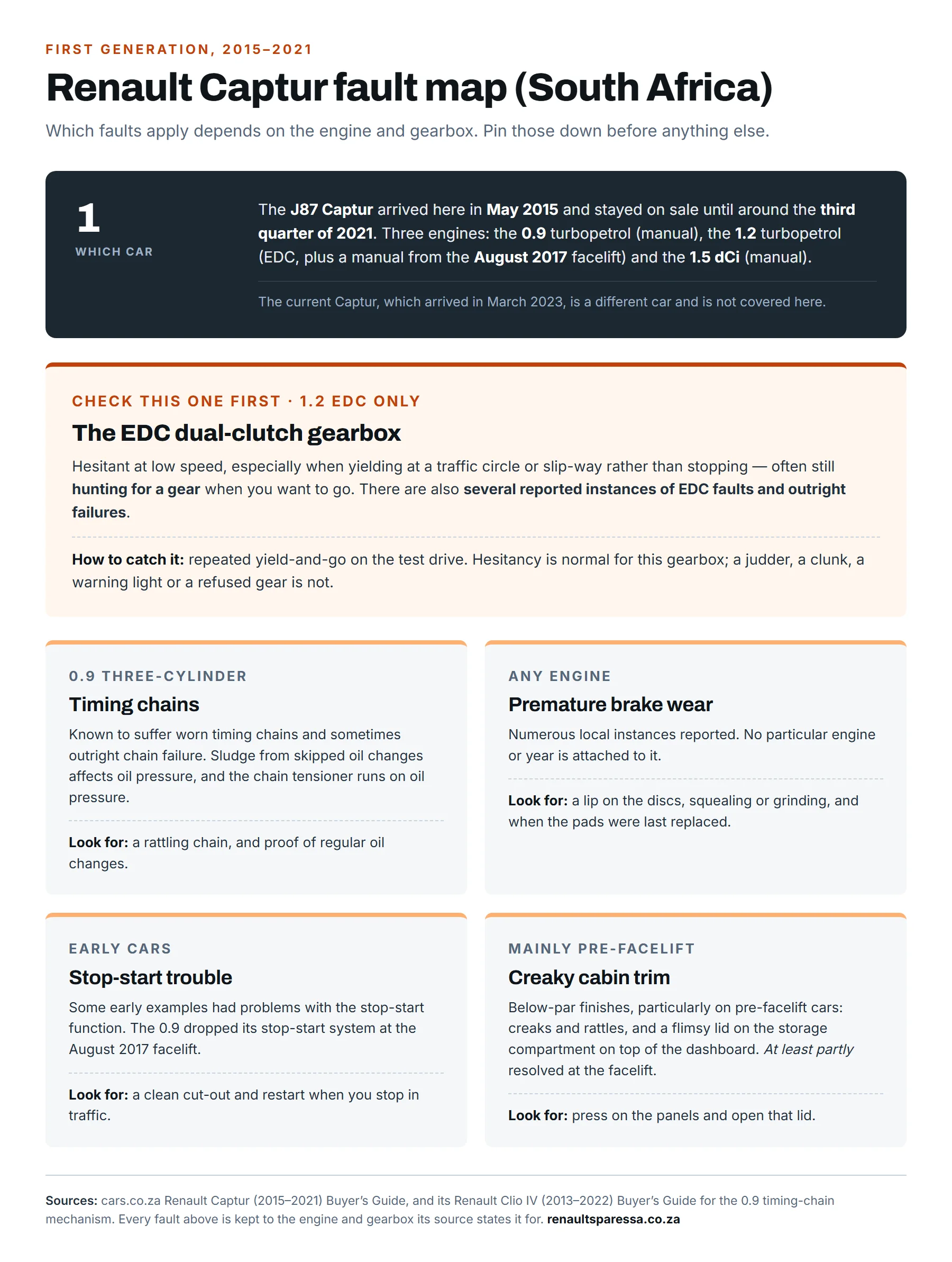
The EDC dual-clutch gearbox — check this first
EDC stands for Efficient Dual Clutch, and the version paired with the Captur’s 1.2 turbopetrol was, in the words of our source, by no means the smoothest-shifting dual-clutch around. In certain low-speed situations it shows an annoying hesitancy, particularly when you are yielding — easing up to a traffic circle or a slip-way — rather than coming to a complete stop. When you are ready to go, the gearbox is often still hunting for a gear.1
That alone is a matter of taste. The part that matters for an owner is the next sentence: the same source says it has also heard of several instances of EDC faults and outright failures.1 “Several instances” is the source’s wording, and we are not going to turn it into a failure rate.
Because some hesitancy is simply how this gearbox behaves, it is easy to miss a gearbox that is actually getting worse. On a test drive, roll up to a yield sign and pull away again several times, and pay attention to anything that feels new: a judder, a clunk, a warning light or a gear it will not take.
If the gearbox is the worry, find out exactly what is wrong before you price anything. A gearbox that has been diagnosed is a specific part; “it feels funny” is not. Be clear whether your car is the 1.2 EDC or the post-2017 1.2 six-speed manual — same engine, entirely different gearboxes.
Timing chains on the 0.9 three-cylinder
The 0.9 turbopetrol is the engine you will meet most often in used Captur listings, and the main fault to know about is that it was known to suffer from worn timing chains and sometimes even outright timing-chain failures. The advice is to listen closely for a rattling chain and to ask for evidence of regular servicing.1
The same publication’s Clio IV guide, which our Captur source points back to for this fault, explains why servicing is the question to ask. If the oil has not been changed regularly, sludge builds up and affects oil pressure — and the chain tensioner is controlled by oil pressure, which is where problems can start.2 So a stamped service book is not a nice-to-have on this engine; it is the best evidence you will get about the chain. The Sandero’s 0.9 carries the same warning, and our Sandero guide goes through what a worn chain sounds like.
Listen from cold. Ask the seller not to warm the car up before you arrive, then start it yourself, so you hear the engine as it is rather than as it was prepared for you. A rattle that fades as the engine warms is still a rattle worth asking about. Parts for this job sit under engine parts.
Premature brake wear
Our source reports numerous local instances of premature wear on the brakes.1 It does not tie that to a particular engine or year, so neither do we. It is also the easiest item on this list to check yourself: look at the discs through the wheel spokes for a pronounced lip at the outer edge, listen for squealing or grinding, and ask when the brake pads were last done. If they were done recently and already look worn, ask why.
Stop-start trouble on early cars
Some early examples of the J87 Captur had problems with the stop-start function.1 On the test drive, come to a full stop in traffic and see whether the engine cuts out and restarts cleanly when you lift off the brake. Worth knowing when you compare cars: the 0.9 engine dropped both its Eco mode and its stop-start system at the August 2017 facelift.1
Cabin trim that creaks and rattles
Despite coming from Europe, some cabin finishes — particularly on pre-facelift cars — felt decidedly below par. One low-mileage early car showed creaks and rattles, and another had a flimsy pop-up lid on the storage compartment on top of the dashboard. The facelift at least partly resolved this, with a soft-touch dashboard, some satin-chrome trim, a new steering-wheel design and some better interior panels.1
A broken lid or a loose panel is exactly the kind of small interior part that is easier to replace with a matching used one than to glue. Note whether the car is pre- or post-facelift before you ask, because the panels changed.
One more to check: the plastic thermostat housing
This one is not reported for the Captur, so read it as a thing to look at rather than a known fault. On the Clio IV, a Renault specialist described a tendency for the plastic thermostat housing on three-cylinder models to warp over time, generally past the 100 000 km mark, leading to a coolant leak.2 If you are looking at a high-mileage 0.9 Captur, a quick look for coolant residue around the housing and a check of the coolant level costs nothing. If you do find a leak there, the housing is a cooling system part.
What the used market looks like
When cars.co.za counted the first-generation Captur listings on its site in October 2025, about 71% were manuals. The 0.9 made up just over half, the 1.2 about 42% and the diesel just 6%, and not one of the 100 Sunset editions was listed.1 That is one site on one date, not every Captur on the road, but it gives you an idea of what is out there.
The same guide’s verdict is worth repeating because it lines up with the faults above. Its author would likely side-step the 0.9, which can feel breathless when the car is loaded and at higher altitudes — something to weigh on the Highveld. It would probably avoid the EDC for its low-speed hesitancy. Its pick is the 1.5 dCi Dynamique, preferably facelifted — with the catch that the diesel is in fairly short supply.1
A buying checklist
- Establish the engine, gearbox and whether it is pre- or post-facelift (August 2017). Everything else follows from those three.
- 1.2 EDC: test the gearbox at low speed — repeated yield-and-go, not just a straight run. Hesitancy is normal for this gearbox; judder, clunks, warning lights and refused gears are not.
- 0.9: listen for a chain rattle, ideally starting the car yourself before the seller has warmed it up. Ask for proof of regular oil changes.
- Any Captur: check the brakes — disc lip, noise, and when the pads were last replaced.
- Early cars: test the stop-start in traffic.
- Press on the cabin trim, especially on a pre-facelift car, and open the storage lid on top of the dashboard.
- High-mileage 0.9: look for coolant around the thermostat housing.
What we could not establish
- How common the EDC faults are. Our source says it has heard of “several instances” of faults and outright failures. It gives no number, and we have not invented one.
- Which part of the EDC fails. Our source reports faults and failures without saying what failed, so we cannot tell you whether it is the clutches, the control side or the gearbox itself.
- Whether the thermostat housing problem affects the Captur. It is reported for three-cylinder Clio IV models. Our Captur source does not mention it either way.
- South African owner reports for this generation. We searched for first-hand reports from local J87 owners and the ones we found were about the newer Captur or other models, so none are quoted here.
- Parts prices and repair costs. Neither of our sources gives a parts price or repair cost for these jobs, so none is given.
Need a part for a Captur?
Tell us the year, whether it is the 0.9, the 1.2 or the dCi, and whether it is manual or EDC. On a Captur those three answers narrow it down almost completely.
Before you act on this
This guide is research, not a diagnosis of your car. Renault Spares SA supplies parts — we are not a licensed repair workshop, and we have not seen your vehicle. Have a qualified technician confirm the fault before you buy a part or start a job.
Sources
- Renault Captur (2015-2021) Buyer's Guide — cars.co.za
- Renault Clio IV (2013-2022) Buyer's Guide — cars.co.za
Need the part this guide points at?
Give us the model, the year and what failed. We will come back on what we can source and what it costs.
More Renault guides
Renault Duster Problems in South Africa: the 2013-2018 and 2018-2025 Cars
What goes wrong on the used SA Renault Duster - rust spots and ignition coils on the 2013-2018 car, turbo failures, clogged DPFs and the 4-year cambelt on the 2018-2025 diesel - with every fault kept to the generation it belongs to.
Renault Kwid Problems in South Africa: What the Local Evidence Actually Says
Most Renault Kwid fault lists online describe Indian cars. This guide sticks to South African sources - the November 2019 ABS and airbag line, the Global NCAP result, how the Easy-R gearbox really works, and the one SA recall on record.