
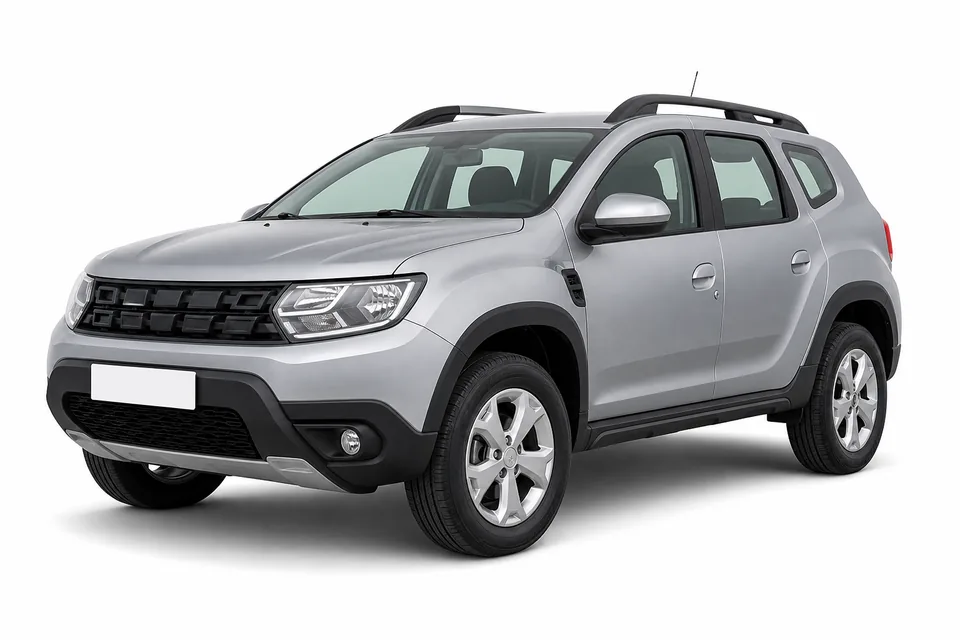
Renault Duster Problems in South Africa: the 2013-2018 and 2018-2025 Cars

The short version
- This guide covers the first-generation (October 2013–2018) and second-generation (October 2018–2025) Dusters — the ones actually in the used market. They have different problems, so work out which you are dealing with first.
- Two newer Dusters exist and are not covered here: the Romanian-built third generation from March 2025, and an India-built Duster launched on 13 August 2026. Do not apply anything below to those cars.
- First generation: check for rust in specific places, water in the rear footwells on early cars, a wobbly driver's seat, and dying ignition coils on the petrol.
- Second generation: turbo failures and clogged diesel particulate filters on the 1.5 dCi, and a hesitant dual-clutch gearbox.
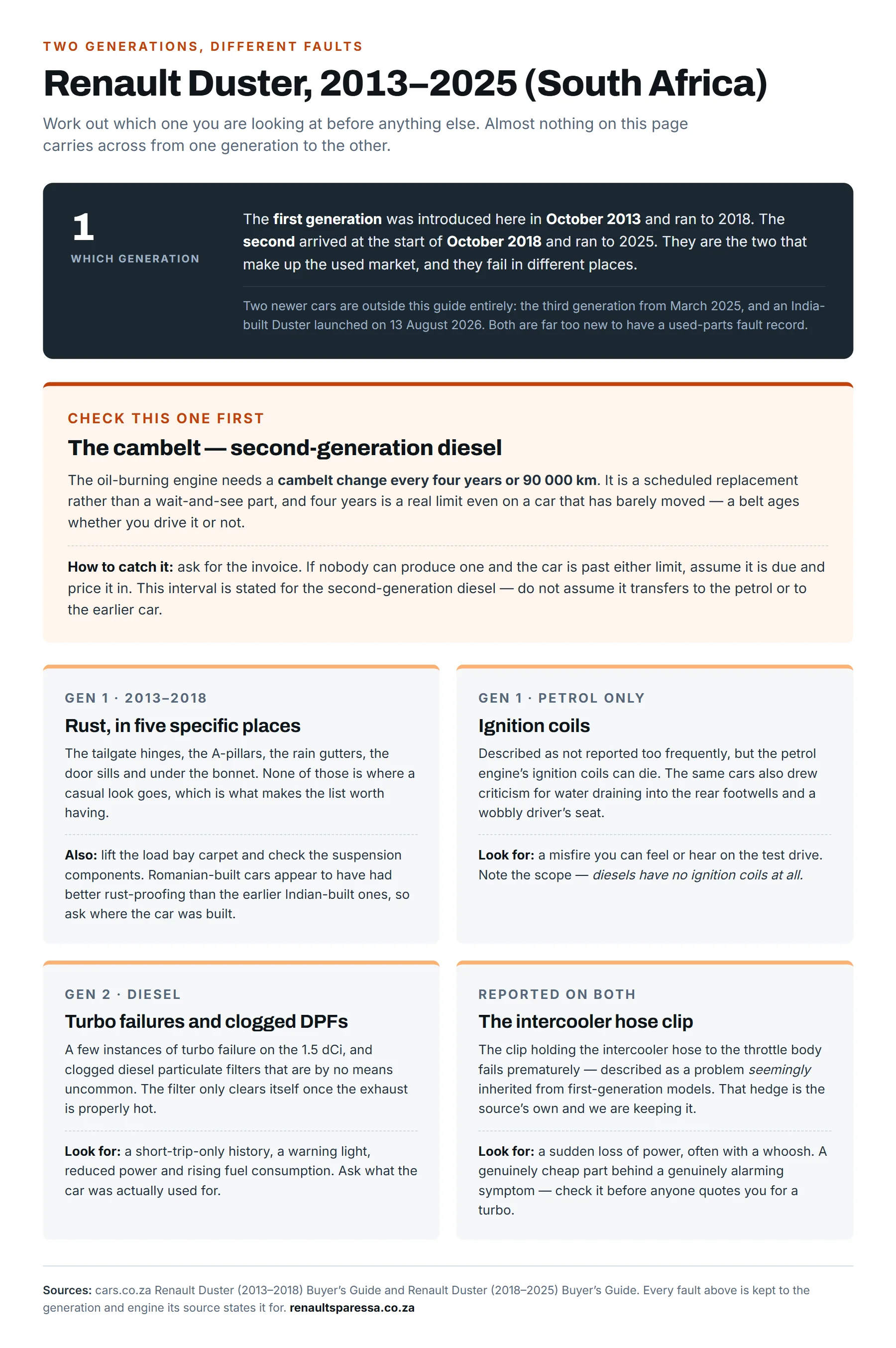
- The second-generation diesel needs a cambelt every 4 years or 90 000 km. Ask for the invoice before you buy one.
- One small part is reported to fail on both generations — the clip holding the intercooler hose to the throttle body — though only our second-generation source mentions it.
The Duster is the Renault that South Africans keep. It is cheap to buy, genuinely useful, and the diesel will do the kind of mileage that makes a bakkie owner think twice. That also means there are plenty of used Dusters about now, and the older ones are well past the point where the dealer network wants to know about them.
The single most useful thing to understand before you buy parts for one is that "a Duster" in South Africa now covers two used generations and two current cars, and they have very little in common in what fails. This guide is about the two that make up the used market — the first generation from October 2013 and the second from October 2018 — and it separates those two properly.
Scope, stated up front. After the second-generation car, the third-generation Duster arrived in South Africa in March 2025,2 and an India-built Duster launched here on 13 August 2026.3 Nothing in this guide applies to either of those. Both are far too new to have a used-parts fault record. The 2026 car is built in India rather than Romania, and our source says its local powertrain lineup was still unconfirmed when the launch date was announced — so we are not going to tell you what is under its bonnet either.3 If your Duster is a 2025 or 2026 car, stop reading and talk to us directly instead.
Everything below is from South African motoring sources, listed at the end.
First, work out which Duster you have
The first-generation Duster was introduced in South Africa during October 2013, with a facelift in August 2015 and a limited-edition EXPLORE version in June 2016.1 The second-generation car — the HM-series — hit the South African market at the start of October 2018, and the third-generation Duster arrived in March 2025.2
Where they were built changed along the way, and that is worth knowing when you are sourcing parts. Dusters sold here were initially built in India; as of the introduction of the revamped version, production shifted to a plant in Romania.1 All South African second-generation cars were built at Dacia's Mioveni factory in Romania.2
The engine and gearbox map
This is the table to have open when you phone a parts counter.
| Generation | Engine | Output | Gearbox / drive |
|---|---|---|---|
| 1st (2013–2018) | 1.6 16-valve petrol | 75 kW / 145 Nm | 4×2 only, Expression and Dynamique |
| 1st (2013–2018) | 1.5 dCi diesel | 80 kW / 240 Nm | 6-speed manual, 4×2 and 4×4 |
| 1st, from 2017 | 1.5 dCi diesel | not stated by our source | EDC dual-clutch, 4×2 |
| 2nd (Oct 2018 – Nov 2021) | 1.6 16-valve petrol | 84 kW / 156 Nm | 5-speed manual |
| 2nd (from Oct 2018) | 1.5 dCi diesel | 66 kW / 210 Nm | 5-speed manual |
| 2nd (from Oct 2018) | 1.5 dCi diesel | 80 kW / 250 Nm | EDC dual-clutch |
| 2nd, from Mar 2019 | 1.5 dCi diesel | 80 kW / 260 Nm | 6-speed manual only, 4×4, Dynamique |
All three second-generation versions of the 1 461 cc diesel make peak power at 4 000 r/min and maximum torque at just 1 750 r/min.2 Two crossovers are worth noting, because both widen where a part can come from: the first-generation 4×4 used the same all-wheel-drive system as the contemporary Nissan X-Trail, and the EDC gearbox added in 2017 was the same transmission as in the Kadjar.1 Those are platform-level statements, so treat them as a lead worth chasing on a specific part rather than a guarantee that any given component swaps across.
First-generation faults (2013–2018)
Rust — and exactly where to look
Some earlier cars can show signs of rust, and the advice is to inspect carefully. The specific places named are the tailgate hinges, the A-pillars, the rain gutters, the door sills and under the bonnet.1
That list is more useful than a general "check for rust", because none of those spots are where a casual look goes. The A-pillars are the posts either side of the windscreen; the rain gutters run along the roof edges above the doors. Open the tailgate and look at the hinges themselves rather than the painted panel around them. If you are viewing a coastal car — and on our roads that means anywhere along the KZN or Cape coast — give all five areas real attention. Our source adds two more places worth a look while you are down there: lift the load bay's carpet, and check the suspension components.1
Where the car was built is the most useful shortcut here. Romanian-built cars appear to have benefitted from better rust-proofing and paint quality than the earlier Indian-built ones.1 Our source ties the change of plant to the revamped version rather than giving a cut-off date, so ask the seller where the car was built instead of trying to work it out from the year.
Water in the rear footwells
On some early cars, a channel or cavity in the underbody resulted in water draining into the rear footwells.1 Lift the rear carpets and feel underneath rather than trusting your eyes — a damp underlay dries on the surface and stays wet below. A musty smell with the car shut up is the other tell. Water sitting in a footwell is not just unpleasant; it rots the floor and it sits directly under wiring.
The wobbly driver's seat
On several cars inspected, the driver's seat was wobbly, apparently caused by the height-adjustment mechanism.1 Rock yourself side to side in the seat before you drive off. Our source calls it "quite an irritating issue" and says to have it attended to by the dealer or owner rather than living with it.1
Ignition coils on the petrol
Described as not reported too frequently, but worth watching for: the petrol engine's ignition coils can die. If the coils are suspect, you should be able to feel or hear a misfire during a test drive.1
An ignition coil is what turns the car's 12 volts into the tens of thousands of volts a spark plug needs. When one weakens, that cylinder stops firing cleanly — you feel it as a stumble or a shudder, usually worst when pulling away or accelerating hard. Note the scope: this one is stated for the petrol engine. Diesels have no ignition coils at all.
The same generation also drew criticism for excessive noise and loose trim and rattles.1 Annoying rather than expensive — but do not let a rattly cabin mask a rattle that is actually coming from underneath.
If you are looking at a 4×4. Previous owners of the 4WD derivatives might have been tempted to venture a little too far off-road, so check the underbody for signs of off-road damage.1 Get it on a lift if you can. Look at the sump, the exhaust, the rear differential and the suspension mounting points — scrapes and dents on those tell you the car has been used the way the badge suggests, and a bent or cracked sump on a diesel is not a cheap conversation.
Second-generation faults (2018–2025)
Turbo failures and clogged DPFs on the 1.5 dCi
This is the pair to take seriously on the diesel. There have been a few instances of turbo failures on the 1.5 dCi engine, and clogged diesel particulate filters are by no means uncommon.2
The DPF is a filter in the exhaust that traps soot. It cleans itself by burning that soot off, but the burn-off only happens once the exhaust is properly hot — which needs a decent run, not a stop-start crawl. A Duster used only for short school runs and traffic never gets there, and the filter gradually blocks. The symptoms are a warning light, a car that goes into reduced power, and rising fuel consumption.
The cheapest useful habit for a Duster diesel owner is a proper run at sustained speed every couple of weeks, because that is what lets the filter clear itself. Our source lists the turbo failures and the clogged DPFs as two separate things and does not say one causes the other, so we are not going to tell you it does. If you are buying, ask what the car has actually been used for — a highway-commuter Duster and a suburban-errand Duster on the same odometer reading are not the same car. Turbochargers are our turbochargers category; note that a DPF is a separate item and is not the same thing as a catalytic converter.
The intercooler hose clip — the one fault reported on both generations
A clip attaching a hose that runs from the intercooler to the throttle body is known to fail prematurely — described as a problem seemingly inherited from first-generation models.2 That "seemingly" is the source's own hedge and we are keeping it.
The intercooler cools the air after the turbo has compressed it. If the clip lets go, that pressurised air escapes before it reaches the engine. You get a sudden loss of power, often with a whoosh, and it will feel far more serious than it is. This is a genuinely cheap part behind a genuinely alarming symptom — worth checking before anyone starts quoting you for a turbo.
The EDC dual-clutch gearbox
The six-speed dual-clutch transmission sometimes felt somewhat hesitant, rendering the Duster a little flat-footed in certain driving scenarios.2
A dual-clutch gearbox is two automated clutches working alternate gears — quick when it guesses right, hesitant when it does not, particularly pulling into moving traffic — the same low-speed hesitancy is reported on the petrol EDC in the first-generation Captur. What is written above is a description of how it behaves, not a fault report, and we are not going to inflate it into one. Drive one before you decide whether the hesitancy bothers you. Our source balances it in the same breath: provided you are not in a hurry, it generally provided well-timed shifts, and it was an improvement on the first-generation dual-clutch.2 If you are pricing gearboxes, be clear about whether yours is the EDC or a manual — they are entirely different units.
Rear airbags
Worth knowing if you carry children: the base Expression shipped with dual front airbags and other derivatives added front side airbags, but there was no airbag coverage for the rear passengers.2
The crash-test record is mixed, and the detail matters more than the summary. The Dacia Duster scored 3 stars in its 2017 Euro NCAP test. A dual-airbag, Renault-badged version was given 4 stars by Latin NCAP in 2019, and that rating was downgraded to zero stars in 2021, after a second tested vehicle showed "unstable structure performance and a fuel leakage" in the front-impact test.2
Read the scope before you draw a conclusion from that, because none of those tests is of a South African car. The Euro NCAP result is a Dacia-badged car, and our source notes it is not clear where the 2021 Latin NCAP vehicle was built — the official report lists it only as "made in Brazil and Romania". What is stated for our market is that all SA-spec derivatives came standard with electronic stability control and ABS with EBD.2
The cambelt — do not skip this bit
The second-generation diesel requires a cambelt change at intervals of four years or 90 000 km.2 Our source states the interval as "four years or 90 000 km" and does not spell out which of the two binds first. Treat the four years as a real limit anyway, even on a car that has barely moved — a belt ages whether you drive it or not.
The cambelt (or timing belt) keeps the top and bottom of the engine turning in step. Unlike a chain, it is a consumable with a published replacement interval — it is replaced on a schedule rather than when it fails, and a belt that has been left past its interval is not a saving. None of our sources describes what happens when one lets go on this engine, so we are not going to tell you.
So when you look at a second-generation diesel Duster, the belt history is not a nice-to-have. Ask for the invoice. If nobody can produce one and the car is over four years old or past 90 000 km since the last one, assume it is due and budget accordingly — and factor that into what you offer. This interval is stated for the second-generation diesel; do not assume it transfers to the petrol or to the earlier car.
A buying checklist
- Establish the generation first. October 2013 to 2018, or October 2018 onward. Everything else follows from that.
- Gen 1: check the five rust spots — tailgate hinges, A-pillars, rain gutters, door sills, under the bonnet — then lift the load bay carpet and look at the suspension components.
- Gen 1: lift the rear carpets and feel underneath for damp.
- Gen 1 petrol: feel for a misfire on the test drive.
- Gen 2 diesel: ask for the cambelt invoice. The stated interval is four years or 90 000 km.
- Gen 2 diesel: ask how the car was used. Short trips only is the DPF risk profile.
- Any 4×4: inspect the underbody for off-road damage.
- Rock the driver's seat before you pull away.
What we could not establish
- How common the turbo failures are. The source says "a few instances". That is deliberately vague and we have not sharpened it into a number.
- Whether any crash-test rating describes an SA-spec Duster. The 3-star Euro NCAP result is a Dacia-badged car, and our source says the official Latin NCAP report lists the zero-star 2021 vehicle only as "made in Brazil and Romania", so we cannot tell you it was built where ours were.
- Labour costs in rand for any of these jobs. No sourced, dated South African labour figure was found. Our gen-1 source does carry a dated Renault parts-price table, but those are 2019 prices for parts alone and we judged them too stale to republish as current.
- Whether specific X-Trail or Kadjar parts actually interchange. The shared all-wheel-drive system and shared EDC are platform-level statements. Any individual part needs checking on its own merits before you buy it.
Need a part for a Duster?
Tell us the year, whether it is petrol or dCi, and whether it is manual, EDC or 4×4. Those four answers narrow it down almost completely.
Before you act on this
This guide is research, not a diagnosis of your car. Renault Spares SA supplies parts — we are not a licensed repair workshop, and we have not seen your vehicle. Have a qualified technician confirm the fault before you buy a part or start a job.
Sources
- Renault Duster (2013-2018) Buyer's Guide — cars.co.za
- Renault Duster (2018-2025) Buyer's Guide — cars.co.za
- New (India-built) Renault Duster SA launch date confirmed (11 August 2026) — CAR magazine
Need the part this guide points at?
Give us the model, the year and what failed. We will come back on what we can source and what it costs.
More Renault guides
Renault Captur Problems in South Africa: the 2015-2021 Captur
What goes wrong on the used first-generation Renault Captur in South Africa - the hesitant EDC gearbox on the 1.2 and its reported faults, timing chains on the 0.9, premature brake wear, early stop-start trouble and creaky pre-facelift trim - kept to the engine and gearbox each fault belongs to.
Renault Kwid Problems in South Africa: What the Local Evidence Actually Says
Most Renault Kwid fault lists online describe Indian cars. This guide sticks to South African sources - the November 2019 ABS and airbag line, the Global NCAP result, how the Easy-R gearbox really works, and the one SA recall on record.