
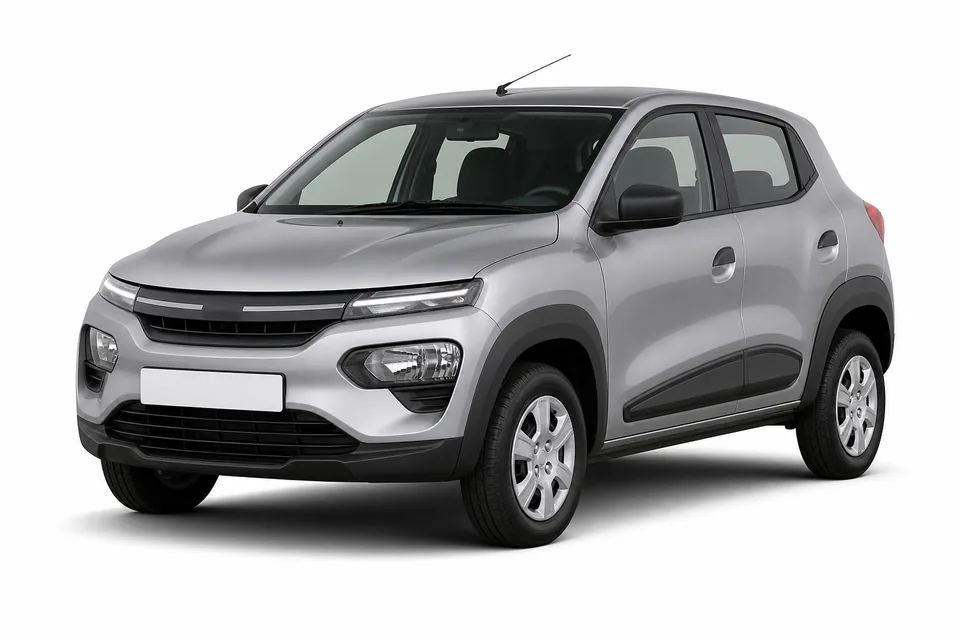
Renault Kwid Problems in South Africa: What the Local Evidence Actually Says

The short version
- The Kwid launched here at the end of 2016, and the cars sold in South Africa are made in India.
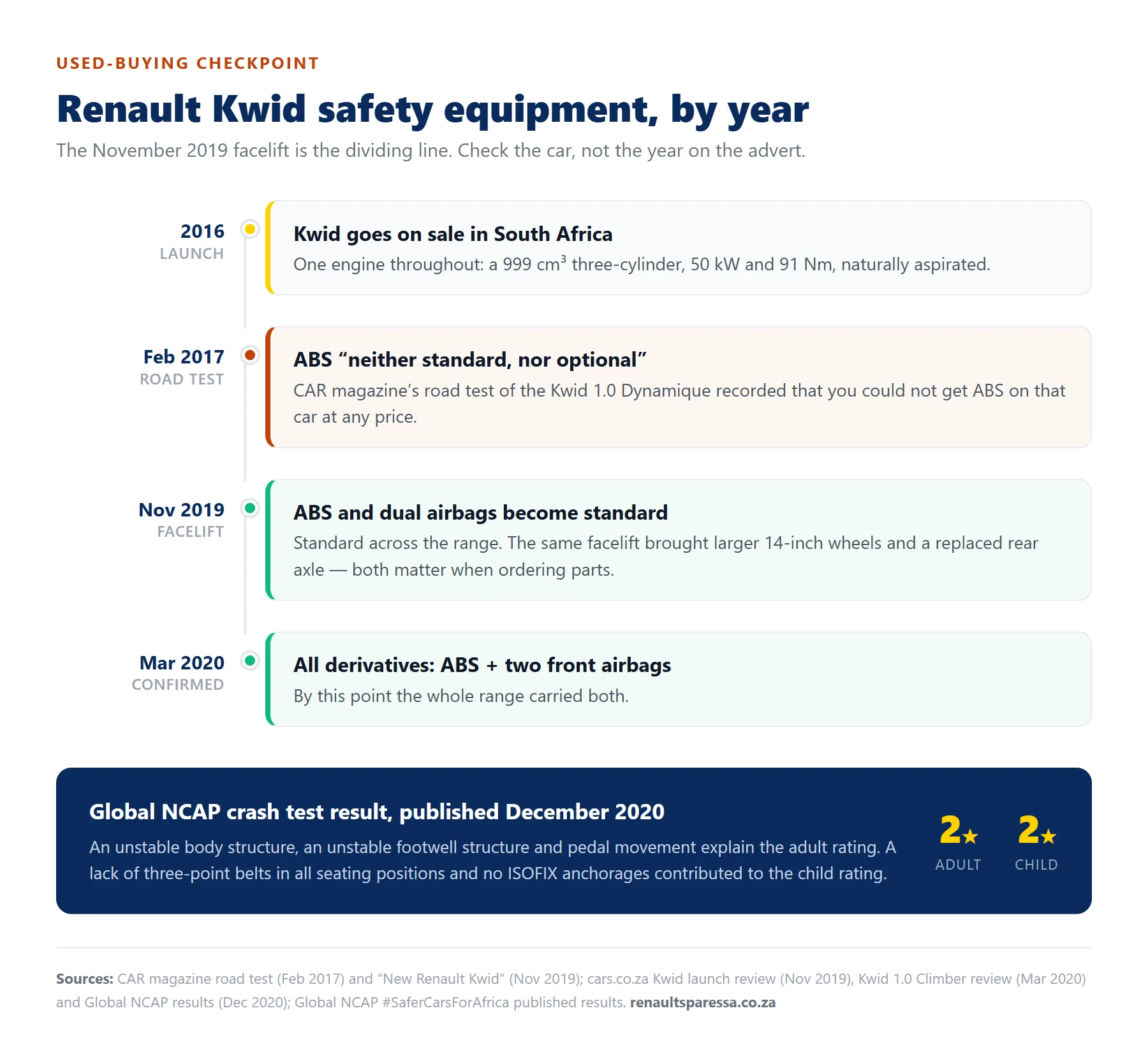
- The single most important used-buying fact: ABS and two airbags only became standard across the range with the November 2019 facelift. A pre-facelift car may have neither.
- Global NCAP gave the South African Kwid two stars for adult and two for child protection, citing an unstable body structure and footwell.
- The Easy-R "automatic" is not a normal automatic — it is a manual gearbox with a computer working the clutch. That changes what you buy when something goes wrong.
- South Africa's only Kwid recall on record affected unsold showroom stock, not cars already on the road.
The Kwid is the car that got a lot of South Africans into their first set of keys, and it has been on sale here without a break since 2016 — so there are plenty of them about. The oldest are now approaching ten years old, well out of warranty, and squarely in used-parts territory.
It is also a car where a lot of what you will read online is about a different market. The Kwid is built in India and sells in enormous numbers there, so most of the fault lists you will find describe Indian cars in Indian conditions. This guide sticks to what South African sources actually say — and where that leaves a gap, it says so instead of borrowing.
What the South African Kwid is
The Kwid launched in South Africa at the end of 2016.2 It has one engine: a 999 cm³ three-cylinder producing 50 kW and 91 Nm, naturally aspirated — no turbo.1 The model sold in South Africa is made in India.5 The automated-manual option arrived later: the Kwid AMT was launched here in March 2018.7 By the November 2019 range, the choice was a five-speed manual or a five-speed automated manual.3
So on the earliest cars, manual is the only option you will find. What changes over the model's life — significantly — is the safety equipment and some of the running gear.
The November 2019 line: the most important thing on this page
With the facelift covered in November 2019, ABS and dual airbags became standard across the range.3 Before that, they were not a given. CAR magazine's February 2017 road test of the Kwid 1.0 Dynamique recorded flatly that "ABS is neither standard, nor optional".1 If you are buying a used Kwid, check the actual car in front of you for ABS and count the airbags. Do not assume from the year, and do not take the advert's word for it.
ABS — the anti-lock braking system — is what stops the wheels locking under hard braking so you can still steer while stopping. On a light car on a wet Highveld road, that is not a luxury feature.
The same facelift brought other changes that matter for parts: the car moved to larger 14-inch wheels and the rear axle was replaced.3 So when you order anything wheel, tyre or rear-suspension related, the facelift is a real dividing line — give the year, not just "a Kwid".
By March 2020, all derivatives featured ABS and two front airbags.4
Crash safety: what Global NCAP actually found
In results published in December 2020, Global NCAP rated the Kwid two stars for adult occupant protection and two stars for child occupant protection. The reasons given for the adult rating were an unstable body structure, an unstable footwell structure and pedal movement. For the child rating, the lack of three-point seat belts in all seating positions and the lack of ISOFIX anchorages contributed.5
"Unstable body structure" is the phrase to sit with, and it has a practical consequence beyond the obvious one. It means the shell deforms in ways that are hard to put right. If you are looking at a used Kwid that has been in a front-end shunt, be much more sceptical than you would be with a bigger car — and be careful about cheap accident-damaged cars sold as easy rebuilds. Straight panels do not prove a straight structure. Our body parts section covers panels, but a bent structure is a job for a proper straightening jig and a measurement report, not a set of new panels.
The Easy-R gearbox: know what you are actually buying
Renault calls the Kwid's automatic option Easy-R. It is an automated manual transmission, and the distinction is not pedantry. As one South African review puts it, the Kwid "has a manual gearbox with a regular clutch unit, but no clutch pedal".8 Another describes it as working "just like a conventional manual car, except there is no third pedal; the clutch is controlled by a computer".7
Why this matters when something goes wrong. An Easy-R Kwid does not have a torque-converter automatic or a dual-clutch box inside it. It has an ordinary manual gearbox and an ordinary clutch, plus the mechanism that operates that clutch for you. So if someone quotes you for an "automatic gearbox" on a Kwid without asking which parts have actually failed, they may be quoting for the wrong thing entirely. Get the diagnosis specific before you buy anything from our gearboxes category.
How it drives is well documented and consistently criticised. The shift is slow, and it lurches: "the transmission takes an age to swap cogs. Not only is it slow, but it's not smooth", with the box lurching as it attempts to select a lower gear.8 The launch review noted the first-to-second shift can lurch a little and that the car does not shift down quickly enough for brisk overtaking.7
There is also a hill quirk worth knowing before you test drive one: "the transmission requires some input from the gas pedal to engage the clutch, which means that on all inclines you either need to drive with both feet or use the handbrake".8 In other words it will roll back on a hill start unless you hold it. That is how the design works, not a sign the car you are driving is broken.
An honest gap. You will find plenty written online about Kwid clutch actuators failing. Every source we could find for that was either Indian-market, a user-review site or a parts listing — we found no South African editorial source documenting it as a pattern here, so we are not going to state it as one. That means our searches found nothing, not that it does not happen. If you are buying an Easy-R car, drive it properly: pull away several times, do a hill start, and treat harsh engagement or a slipping feel as a reason to have it looked at.
What the road tests flagged
CAR magazine's 2017 road test found crude hand-finished sealing in the engine bay, with reams of hand-applied sealant untidily smeared along most of the sheetmetal seams. It recorded an average stopping time of 3,95 seconds, rated "poor", noted numb steering, and reported that wind buffeting nearly saw the Kwid drifting out of its lane.1
Three years and a facelift later, the same themes recur. The 2020 review found the Kwid underpowered when loaded with people and easily unsettled by strong winds, said it struggles to track straight and true, and noted that the steering column is not adjustable, not even for rake.4
Most of that is character rather than failure — it is a light, tall, narrow, 50 kW car, and it behaves like one. But the crosswind sensitivity is a genuine safety note for anyone commuting on open road, and the braking figure is worth remembering when you decide how much life is left in a set of brake pads. On a car that already stops poorly, worn pads are not the place to economise.
The South African recall record
People searching for Kwid problems are often really asking about recalls, so here is what we found. In February 2026, the National Consumer Commission announced a safety recall covering 1 393 Renault Kwid units distributed from 20 January 2026.10 The defect was unexpected illumination of a dashboard warning light, caused by high sensitivity in the vehicle's velocity calculation system, and the remedy was a software update, performed on all affected units before they were released to customers.6
Read that carefully, because it is good news. Those were brand-new cars still in the distribution chain, fixed before customers took delivery. It is not a fault to go hunting for on a used Kwid, and it says nothing about the 2016–2022 cars this guide is mostly about. We did not find any other South African Kwid recall — which means our searches found none, not that none exists.
Running costs
One genuinely positive note, with its limits stated. Drawing on the AA's 2021 Spare Parts Pricing Guide, a June 2022 comparison put the Kwid third cheapest to maintain out of the six models it was measured against — the Datsun Go, Hyundai Atos, Kia Picanto, Toyota Agya and Suzuki Swift.9 Third of six is mid-table, not a headline win, and it is worth knowing which six.
That article also carries rand totals for each car's parts basket. We have not quoted them, because they come from the 2021 report and parts prices move faster than almost anything else on this page — a five-year-old basket total would read as current and would not be. The ranking is the part that survives; the rand figures are not.
The Kwid came with a five-year/150 000 km warranty.3 On a 2016 or 2017 car, that has expired on time even if the mileage is low.
A buying checklist
- Check for ABS and count the airbags on the actual car. This is the single highest-value check on a used Kwid, and it turns on the November 2019 facelift.
- Be sceptical of any accident history, given what Global NCAP said about the body and footwell structure.
- Establish manual or Easy-R, and if it is an Easy-R, do several pull-aways and a hill start.
- Do not read roll-back on a hill as a fault on an Easy-R — that is the design.
- Note the year against the facelift before ordering wheels or rear suspension parts.
- Test drive it on open road if you can, so the crosswind behaviour is not a surprise later.
What we could not establish
- Any South African-documented mechanical failure pattern. This is the honest headline. South African coverage of the Kwid is rich on safety, structure and how it drives, and close to silent on which components fail. We did not fill that in with Indian-market fault lists.
- Clutch actuator failure rates. Widely discussed, not documented by any South African editorial source we could find.
- The service plan term. The two sources that mention it render it in a way that contradicts itself, so we have published only the warranty, which is unambiguous.
- What the AA parts baskets actually measure. Real figures, unexplained methodology, so only the ranking is quoted.
- Repair costs in rand. None found from a dated South African source, so there are none here.
Need a part for a Kwid?
Give us the year and whether it is a manual or an Easy-R. On this car the year matters more than usual — the facelift changed the wheels and the rear axle.
Before you act on this
This guide is research, not a diagnosis of your car. Renault Spares SA supplies parts — we are not a licensed repair workshop, and we have not seen your vehicle. Have a qualified technician confirm the fault before you buy a part or start a job.
Sources
- ROAD TEST: Renault Kwid 1,0 Dynamique (15 February 2017) — CAR magazine
- New Renault Kwid (29 November 2019) — CAR magazine
- Renault Kwid (2019) Launch Review (19 November 2019) — cars.co.za
- Renault Kwid 1.0 Climber (2020) Review (10 March 2020) — cars.co.za
- Global NCAP Results: Kwid, H1, Steed 5 (4 December 2020) — cars.co.za
- Safety Recall: 1,393 Renault Kwids Flagged for Software Update (24 February 2026) — AutoTrader South Africa
- Renault Kwid AMT (2018) Launch Review (9 March 2018) — cars.co.za
- Renault Kwid AMT - 5 things you should know (31 May 2018) — Double Apex
- Is a Renault Kwid expensive to maintain? (10 June 2022) — AutoTrader South Africa
- Renault recalls 1,393 Kwid cars in South Africa (4 February 2026) — TimesLIVE
Need the part this guide points at?
Give us the model, the year and what failed. We will come back on what we can source and what it costs.
More Renault guides
Renault Captur Problems in South Africa: the 2015-2021 Captur
What goes wrong on the used first-generation Renault Captur in South Africa - the hesitant EDC gearbox on the 1.2 and its reported faults, timing chains on the 0.9, premature brake wear, early stop-start trouble and creaky pre-facelift trim - kept to the engine and gearbox each fault belongs to.
Renault Duster Problems in South Africa: the 2013-2018 and 2018-2025 Cars
What goes wrong on the used SA Renault Duster - rust spots and ignition coils on the 2013-2018 car, turbo failures, clogged DPFs and the 4-year cambelt on the 2018-2025 diesel - with every fault kept to the generation it belongs to.