
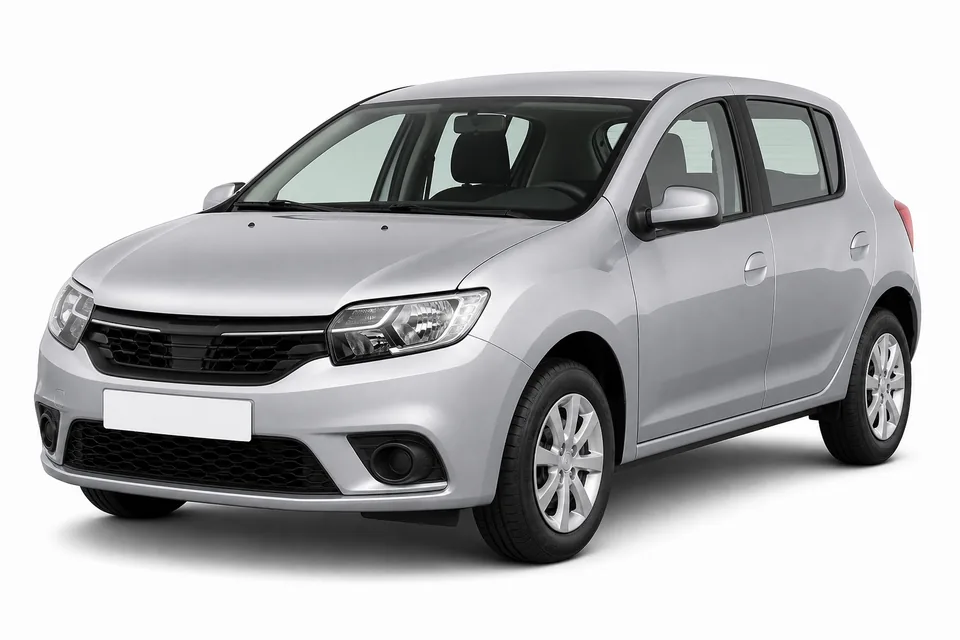
Renault Sandero Problems in South Africa: What Goes Wrong and What to Check

The short version
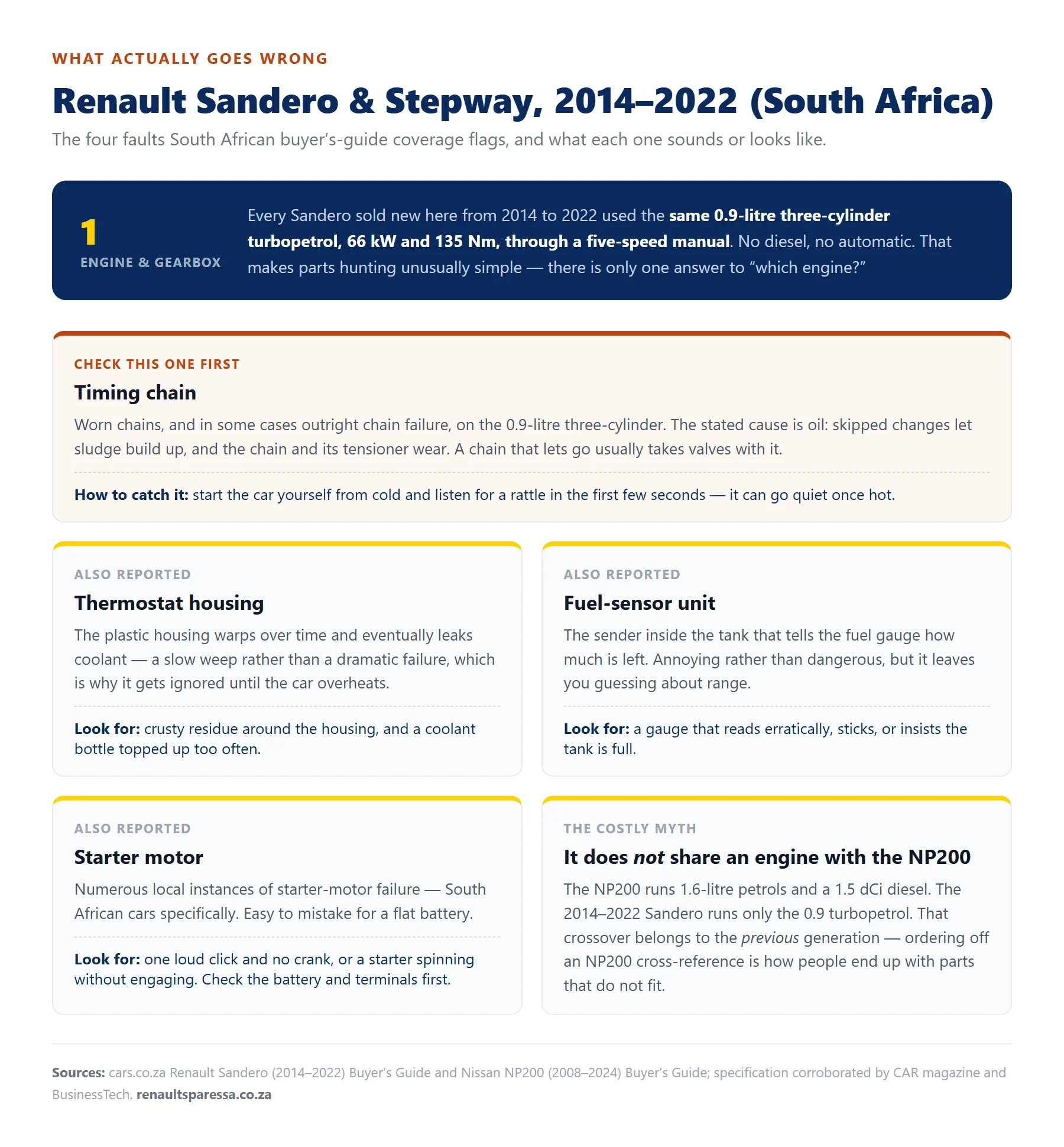
- Every Sandero sold new in South Africa between 2014 and 2022 used one engine and one gearbox — the 0.9-litre three-cylinder turbopetrol and a five-speed manual. That makes parts hunting unusually simple.
- The fault worth checking first is the timing chain. Listen for a rattle on a cold start and on the test drive.
- Three smaller known weak points: the thermostat housing (plastic, warps, leaks coolant), a fuel-sensor unit, and starter motors.
- Skipped oil changes are the thread running through the worst of it — sludge is what kills these chains.
- The SA Sandero does not share its engine with the Nissan NP200. That crossover is real, but it belongs to the previous generation, not the 2014–2022 cars.
The Renault Sandero is one of the easier cars in South Africa to keep on the road, and that is not a compliment people usually pay to a budget Renault. The reason is boring and practical: Renault SA sold exactly one version of it mechanically, for eight straight years. One engine. One gearbox. No diesel, no hot version, no automatic. When you go looking for a part, there is only one answer to "which one?"
This guide covers what actually goes wrong with those cars, what to listen for before you buy one, and one widely repeated fitment claim that is wrong and could cost you money. Everything here comes from South African motoring sources, listed at the bottom. Where we could not verify something, we have said so rather than filled the gap.
What Renault actually sold here, and when
The second-generation Sandero arrived in South Africa in March 2014 and was imported from Romania. It ran until local stock ran dry in the first quarter of 2022.1 That end date matters more than it looks: it means every Sandero on South African roads today is out of its factory warranty, and dealer parts support for a discontinued model thins out year on year. This is precisely the point at which a car moves onto the used-parts market.
One thing that confuses people searching for parts: in a lot of countries this car is a Dacia, not a Renault. Same car, different badge — here it wore the Renault badge.1 If a listing or a parts catalogue calls it a Dacia Sandero, you are in the right place.
One engine, the whole way through
There was a single powertrain across the whole South African life of the car: a 0.9-litre three-cylinder turbopetrol producing 66 kW and 135 Nm, driving through a five-speed manual gearbox. Peak torque arrives from 2 500 rpm, and the claimed combined fuel figure was 5.2 L/100 km. South Africa never got the 1.5-litre turbodiesel sold in Europe, and never got the 2.0-litre Sandero RS sold in South America.1
Why this is good news. On most model ranges, the first three questions a parts counter asks are which engine, which gearbox and which drive layout. On an SA Sandero there is only one possible answer to all three. Year and trim still matter for body panels, trim and electrics — but the mechanical side is about as simple as South African parts hunting gets.
The main event: timing chains
This is the one to take seriously. The 0.9-litre three-cylinder engine has been known to suffer from worn timing chains, and in some cases outright timing-chain failure. The stated cause is oil: if the car has not had its oil changed regularly, sludge builds up. The advice for anyone test driving one is direct — listen out for rattling timing chains.1
If the term is new to you: the timing chain is the metal chain that keeps the top of the engine turning in step with the bottom. It is not a service item you replace on a schedule the way you would a cambelt on a diesel — it is designed to last the life of the engine. On this one it often does not — the 0.9 in the first-generation Renault Captur carries the same warning — and oil is the reason: when the oil gets old and sludgy, the chain and its tensioner wear. A worn chain rattles. A chain that lets go while the engine is running usually takes valves with it, and at that point you are pricing an engine rather than a chain.
What to actually do on a test drive. Get to the car before the seller has warmed it up, and start it yourself from cold. A tired chain is loudest in the first few seconds after a cold start, when oil pressure has not yet reached the tensioner, and it can go quiet once everything is hot. A car that is already idling in the driveway when you arrive is not necessarily being hidden from you — but you have lost your best chance to hear the fault, so arrange to come back.
The flip side is worth saying plainly, because it is the useful part: a Sandero with a thick book of oil-change history is a much better bet than one with low mileage and no records. On this engine, service history is not paperwork — it is the actual diagnostic.
Three smaller faults worth knowing
Alongside the chain, three other items come up.1
The thermostat housing
The plastic thermostat housing has a tendency to warp over time, and eventually leak coolant. The thermostat is the valve that decides when coolant is allowed to flow to the radiator; the housing is the plastic body it sits in. Warped plastic will not seal, so you get a slow weep rather than a dramatic failure — which is exactly why it gets ignored until the car overheats. Look for crusty white or coloured residue around the housing, and check whether the coolant bottle is being topped up more often than it should be. Related parts sit under cooling.
The fuel-sensor unit
A failing fuel-sensor unit is on the list. That is the sender inside the tank that tells the fuel gauge how much is left. A gauge that reads erratically, sticks, or insists the tank is full when it is not, is the usual symptom — annoying rather than dangerous, but it does leave you guessing about range.
Starter motors
There have been numerous local instances of starter-motor failures — and note "local", meaning South African cars specifically. The classic symptom is a single loud click and no crank, or a starter that spins without engaging. It is easy to mistake for a flat battery, so before you replace anything, have the battery and its terminals checked first. If you do need the part itself, that is our starters category.
What it is like to drive, and why that matters second-hand
Under the heading of the car's disadvantages, the same source is honest about the engine's manners: it lacked a degree of tractability, felt a little sluggish at lower revs, and the power delivery is peaky.1 In plain terms: it is a small turbo engine that does very little below about 2 500 rpm and then wakes up.
That is a character note, not a fault — but it is worth knowing when you test drive one, because a Sandero that feels flat off the line is probably just being a Sandero. Judge it on how it pulls once the turbo is awake, and on noises, not on low-down urge it never had.
Which Sandero is which
The range launched with the Sandero Expression and Sandero Dynamique, and the Stepway followed just a couple of months later. A facelift arrived in 2017. The Stepway Plus succeeded the Dynamique in May 2018, and the Stepway Techroad followed in August 2020.1
The Stepway is the one that looks like a small crossover, and the differences are real rather than cosmetic: 29 mm more ground clearance, at 193 mm, plus front and rear silver skid plates, black wheel-arch trim and functional roof rails.1 The raised ride height is the bit to flag when you order suspension parts — tell whoever is quoting you whether yours is a Stepway or a standard Sandero, because the two do not sit at the same height.
Servicing. The Sandero came with a two-year/30 000 km service plan, with service intervals of 15 000 km.1 Every one of those plans has long since expired, so the oil-change discipline that protects the timing chain is now entirely down to the owner. Ask to see what has been done since the plan ran out, not just the stamps from when it was in force.
The NP200 question — and the mistake to avoid
If you have shopped for Sandero parts in South Africa, someone has told you that the Nissan NP200 shares its running gear. There is something real behind that, and there is a trap in it, so it is worth being precise.
The NP200 is effectively a single-cab bakkie version of the first-generation Dacia Logan. It was built at Nissan SA's Rosslyn factory north of Pretoria, from September 2008 until production was suspended in March 2024 — a sixteen-year run. Its engines were a 1.6 8-valve petrol (64 kW at 5 500 rpm, 128 Nm at 3 000 rpm), a 1.6 16-valve petrol (77 kW/148 Nm) and a 1.5 dCi turbodiesel (63 kW, 200 Nm).2 And the Sandero has genuine local history of its own: the previous generation was built in South Africa, at Nissan's Rosslyn factory, before the 2014 car began arriving from Romania.1
Here is the trap. That shared-engine story belongs to the first-generation Sandero and Logan — the cars built at Rosslyn. The Sandero this guide is about, the 2014–2022 car, used only the 0.9-litre turbopetrol. It shares no engine with the NP200, whose petrols are 1.6-litre and whose diesel is a 1.5 dCi. Ordering a 2016 Sandero part off an NP200 cross-reference is a good way to end up with a box that does not fit.
There is one more thing that jumps out when you put the two lists side by side. The NP200's reported problems include starter-motor maladies, along with clutch judder, clutch failure, aircon trouble and overheating.2 The Sandero's list, independently, includes local starter-motor failures. Two separate South African buyer's guides, two related cars, the same component. We are not going to tell you those two facts have one cause — neither source says so, and we have not verified it. But if you own either car and it will not crank, the starter is a sensible first place to look.
A buying checklist
- Start it from cold, yourself. Listen for a rattle in the first seconds. This is the timing-chain check and it is the most valuable thirty seconds of the whole viewing.
- Read the service book, then look past it. The plan expired years ago. What you want is evidence of oil changes since.
- Look around the thermostat housing for dried coolant residue, and check the level in the expansion bottle.
- Watch the fuel gauge through the test drive. Sticking or jumping points at the sender.
- Crank it a few times across the viewing rather than once, and have the battery tested before blaming a starter.
- Confirm Stepway or standard before you order anything suspension-related.
What we could not establish
In the interest of not padding this out with things that sound right:
- How often timing chains actually fail. The source says the engine "has been known to" suffer worn chains and some outright failures. That establishes a pattern, not a rate, and we are not going to invent a percentage or a mileage.
- What any of this costs to fix in rand. We found no sourced, dated South African repair figure for these jobs, so there are no prices in this guide. If you want a real number for your car, ask us and we will quote on the actual part.
- Whether the Sandero and NP200 starter failures are the same root cause. Both are documented. The link between them is not, and we have left it alone.
Need a part for a Sandero?
Tell us the year, whether it is a Stepway, and what has failed. Because every SA Sandero used the same engine and gearbox, we can usually identify what you need from very little information.
Before you act on this
This guide is research, not a diagnosis of your car. Renault Spares SA supplies parts — we are not a licensed repair workshop, and we have not seen your vehicle. Have a qualified technician confirm the fault before you buy a part or start a job.
Sources
- Renault Sandero (2014-2022) Buyer's Guide — cars.co.za
- Nissan NP200 (2008-2024) Buyer's Guide — cars.co.za
Need the part this guide points at?
Give us the model, the year and what failed. We will come back on what we can source and what it costs.
More Renault guides
Renault Captur Problems in South Africa: the 2015-2021 Captur
What goes wrong on the used first-generation Renault Captur in South Africa - the hesitant EDC gearbox on the 1.2 and its reported faults, timing chains on the 0.9, premature brake wear, early stop-start trouble and creaky pre-facelift trim - kept to the engine and gearbox each fault belongs to.
Renault Duster Problems in South Africa: the 2013-2018 and 2018-2025 Cars
What goes wrong on the used SA Renault Duster - rust spots and ignition coils on the 2013-2018 car, turbo failures, clogged DPFs and the 4-year cambelt on the 2018-2025 diesel - with every fault kept to the generation it belongs to.